The World’s Economic Powerhouses: A Data-Driven Analysis
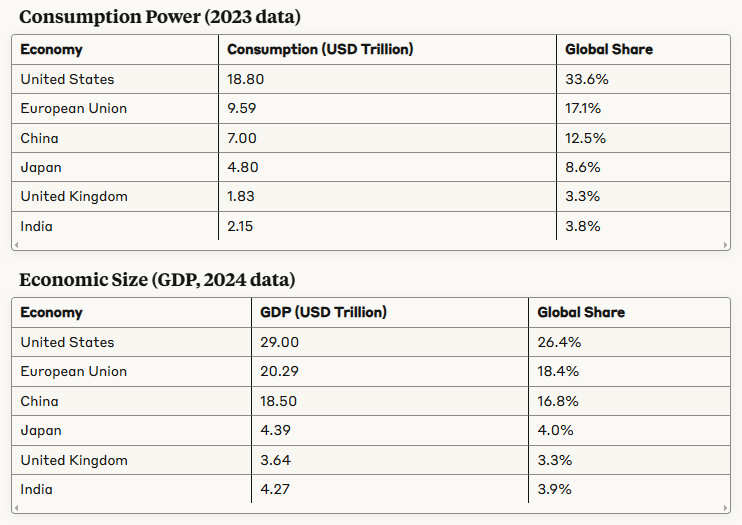
The global economy is predominantly shaped by a small group of economic titans. Our comprehensive analysis of the latest data for 2023-2024 reveals how the United States, European Union, China, Japan, United Kingdom, and India collectively dominate world economic activity across key metrics.
Global Economic Concentration
Six economies—the US, EU, China, Japan, UK, and India—collectively represent:
- 78.9% of global consumption ($44.17 trillion out of $55.97 trillion)
- 72.8% of global GDP ($80.09 trillion out of $110 trillion)
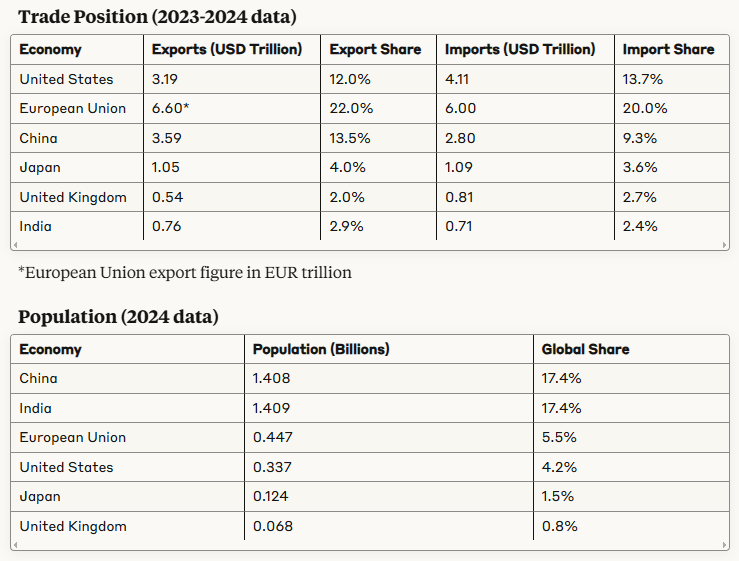
- 56.4% of global exports ($15.73 trillion)
- 51.7% of global imports ($15.52 trillion)
Yet these same economies account for just 46.8% of the world’s population, highlighting the enormous concentration of economic power.
Detailed Economic Profile of Major Economies
The US-China Trade War: Escalation to Breaking Point
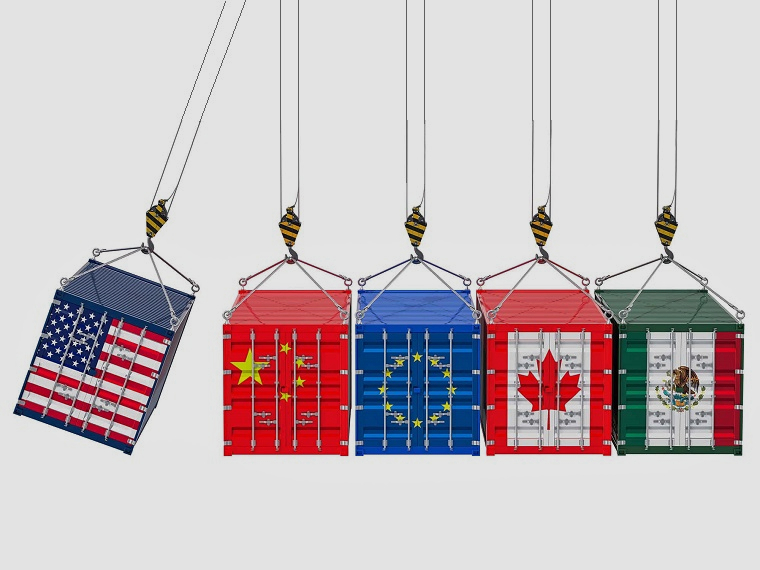
The trade relationship between the world’s two largest economies has deteriorated dramatically in recent weeks, with both sides implementing punitive tariffs at unprecedented levels.
Current Tariff Situation
Recent developments have pushed US-China trade relations to a breaking point:
- The United States has increased tariffs on Chinese goods to over 100%, a massive jump from already elevated levels.
- China has responded with retaliatory tariffs of 84% on US imports, up from 34% previously.
- Both countries have also implemented export controls on strategic materials and placed restrictions on certain companies.
According to recent reports, U.S. tariffs on Chinese exports now stand at 42.1%, which is “more than ten times higher than before the US-China tariff war began in 2018” and “twice as high as the average US tariff on China when the second Trump administration began on January 20, 2025.”
Economic Consequences of Tariff Escalation
The current trade war could have far-reaching implications for the global economy:
1. Direct Economic Impact
- Reduced bilateral trade volume between the world’s two largest economies
- Higher prices for consumers in both countries
- Disruption of global supply chains that have been optimized over decades
- Potential GDP losses for both countries and global economy
2. Market Reactions
Recent market reactions indicate severe concerns:
- Major stock indices have entered correction or bear market territory
- The Nasdaq Composite has confirmed a bear market
- The Dow Jones Industrial Average has entered a correction phase
- Global markets have seen significant volatility
3. Specific Sectoral Impacts
Various sectors will be disproportionately affected:
- Consumer goods: Higher prices for everyday items
- Technology: Disrupted supply chains for semiconductors and electronics
- Agriculture: Reduced exports for farmers
- Manufacturing: Increased input costs and complexity
4. Global Ripple Effects
The consequences extend far beyond the US and China:
- Reduced global trade volume affects shipping and logistics worldwide
- Developing economies dependent on exports face reduced demand
- Trading partners forced to choose sides in escalating conflict
- Potential for currency manipulation and competitive devaluation
The Stakes for Global Economy
Given that the US and China alone account for 43.2% of global GDP and 25.5% of global consumption, their trade conflict threatens the entire global economic system.
The current trajectory risks:
- Global Recession: A protracted trade war could push the global economy into recession by disrupting trade flows, reducing business confidence, and causing financial market instability.
- Inflation Pressure: Higher tariffs directly translate to higher prices for imported goods, creating inflationary pressure when central banks are still battling to control inflation.
- Supply Chain Realignment: Companies may be forced to completely restructure global supply chains, abandoning efficiency for security.
- Geopolitical Fragmentation: The economic conflict reinforces a broader fragmentation of the global order into competing blocs.
Conclusion: A Turning Point for Global Trade
The US-China tariff escalation represents a critical moment for the global trading system that has powered prosperity for decades. With economic titans representing nearly 80% of global consumption now locked in conflict, the consequences will reshape economic relationships worldwide.
As these nations possess both the economic might and political influence to determine the future of global trade, the resolution of this conflict—or its further escalation—will define economic prospects for years to come. Without a diplomatic solution, the economic concentration that has characterized global prosperity could become the very factor that undermines it.